
The jury is out about whether this dessert originated in Australia or New Zealand but it was definitely named after the Russian ballerina Anna Pavlova who toured both countries in the 1920s. It has become an iconic celebratory dessert which most often appears at Christmas time when fresh fruit is at its best in the southern hemisphere. I made this one using Nagi’s well tested version from recipetineats and topped mine with passionfruit, strawberries, blueberries and mint.
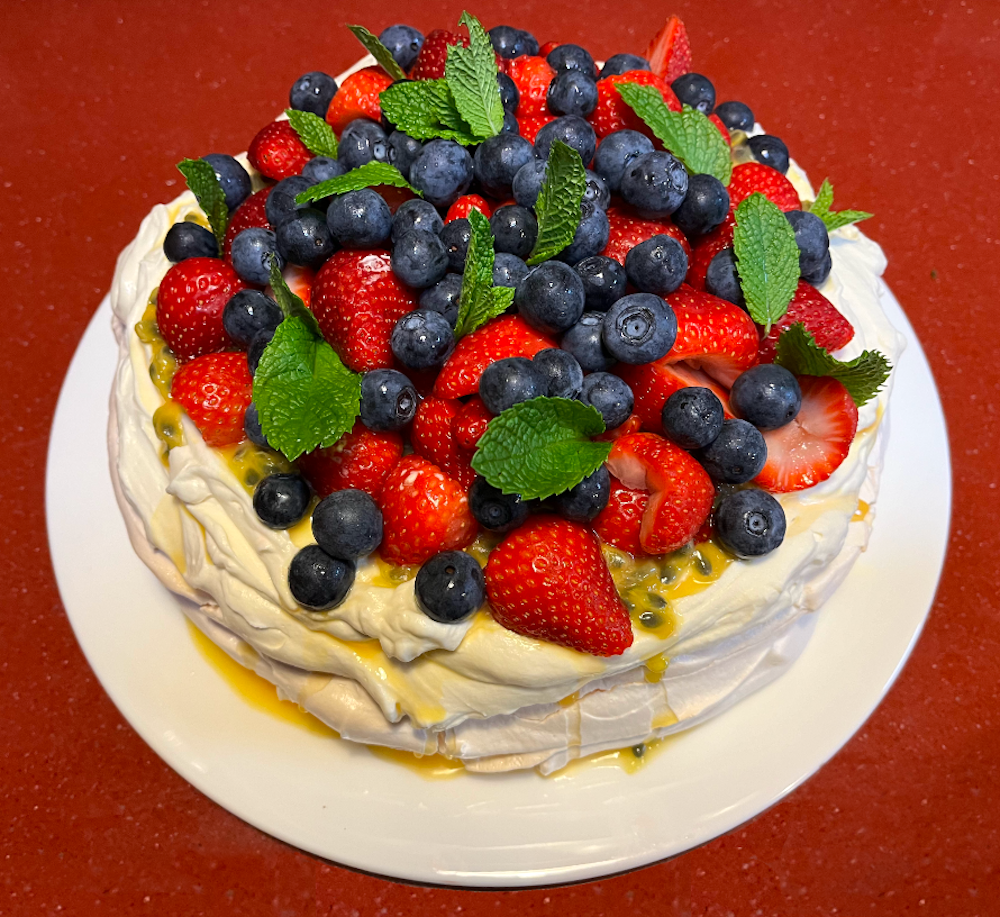
Separate the whites from 4-5 fridge cold eggs until you have 150 ml (5oz) of egg whites and set them aside to come up to room temperature. Preheat your oven to 170°C (340°F). Now beat the egg whites, in a stand mixer if you have one, until you have soft peaks. Now, while beating, slowly add 1 cup of caster sugar one tablespoon at a time. Continue to beat until you can’t feel any sugar in the the egg whites and they are thick and glossy. Add 1 tablespoon of sifted cornflour (cornstarch) and 1 teaspoon of white vinegar. Beat on low or blend with a spatula until just mixed. To make a nice round pavlova, take the bottom of a large springform cake pan and stick some baking parchment onto it with a little of the egg white. Place half of the egg whites on the paper and use the base as a guide to shape it into a circle. Place the rest of the egg whites on top and make a dome shape, flattening the top. The entire pavlova base shouldn’t be more than 4-5cm (2″) high. Carefully transfer to the oven, close the door gently and turn the temperature down to 115°C (240°F ). Bake for 1½ hours then turn the oven off and leave the door closed. The pavlova should remain in the oven as it cools – you can leave it in there for up to 18 hours. Transfer the pavlova, base and all, to a serving platter before sliding the base out and then the paper. When you’re ready to assemble whip 1½ cups of cream with ¼ of a cup of caster sugar and 1 teaspoon of pure vanilla extract. Don’t beat until stiff – it should just hold it’s shape. Slather it onto the pavlova base and decorate with fruit of your choice.
 michelle picker cooks
I love this post! ‘Don’t beat until stiff – it should just hold it’s shape.’ This made a difference to the internal chewiness to the pavlova I made this week. I’ve been trying to get that lovely change of texture inside the the pav but had little success before now.
Details such as, ‘Transfer the pavlova, base and all, to a serving platter before sliding the base out and then the paper’, are often missing in recipe instructions. However, for the more inexperienced cooks, these are invaluable details❣️